

Lot n° 41
Estimation :
5000 - 6000
EUR
Result with fees
Result
: 46 128EUR
[GASTON PHÉBUS. Des deduiz de la chasse des bees sauvaiges e - Lot 41
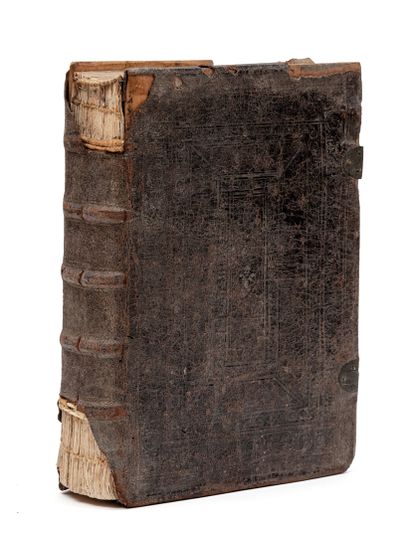
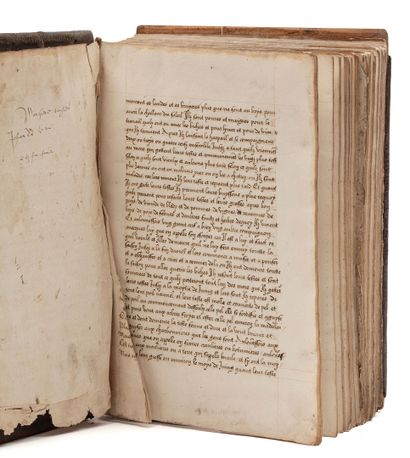
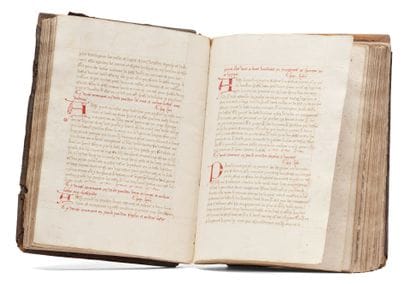
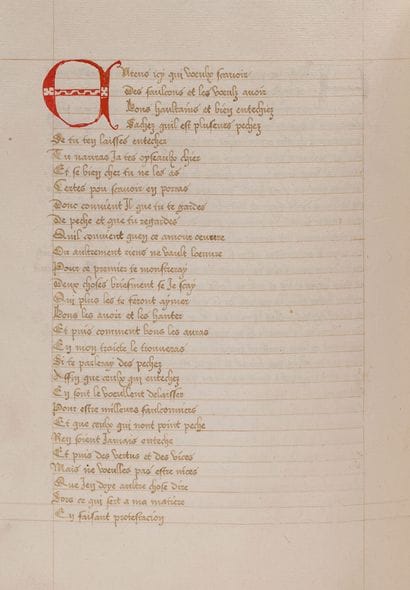
[GASTON PHÉBUS. Des deduiz de la chasse des bees sauvaiges et des oyseaux de proye]. Followed by [GACE DE LA BUIGNE. Roman des deduis]. Artois ?, circa 1520. Manuscript in French, in-4, 19 x 27 cm, 29 lines per page, calligraphy in brown and red ink with yellow paint highlights on laid paper, 40 quires of 8ff. each (the first incomplete by 7ff.): 299ff. of text (out of 306) + 14ff. blank, contemporary binding in brown calf over aisle, broad cold decoration on covers with three frames of roulettes and fillets, central fleuron, five-ribbed mute spine, metal clasp plates, two metal bolts on second board.
Exceptional, unlisted manuscript from the first third of the 16th century of Gaston Phébus' Livre de chasse and Gace de la Bugne's poem, in its original binding.
Fine copy by Jean d'Ostove, seigneur de Neulette, probably based on the princeps edition published in Paris by Anthoine Vénard around 1507.
Manuscript preserved for several generations by a Pas-de-Calais family living in a village very close to Neulette.
First 7 leaves incomplete.
Single-column text in Gothic script, chapter headings in red ink, 2-line high initials in red ink (two in black ink, ff.228 v° & 229 r°), sometimes with watermarked decoration and extending slightly into the margin, numerous line-head capitals highlighted in yellow. Claim on some quires. Reglure in red ink, marginal reglure pitting. Paper, watermarked PM in a crowned shield, manufactured in Messines between 1420 and 1549.
The first seven leaves have been torn, leaving only a small part of their lower corner: the title, introductory poem, prologue, table and the first forty-eight lines (in the 1507 princeps edition) of the text, constituting the very beginning of the chapter on the stag, are missing. ff. 87 v°, 88 & 89 r° are soiled and stained. F. 121 is detached, soiled and frayed, with marginal paper loss but no damage to text. Small tear on f. 209.
Binding rubbed. Significant loss at top and bottom of spine, reaching slightly to boards. Lacks at the top of the boards, at the lower corners and at the edges of the first board.
The Hunting Book of Gaston Phébus
Gaston Phébus's work is considered the most important early French treatise on hunting. It was written by Gaston III de Béarn, known as Fébus ("le flamboyant"), 12th Count of Foix (1331-1391). This literate prince and poet was a remarkable administrator and fine strategist, greatly expanding his possessions and allying himself with the King of France, Charles VI. An avid hunter, he turned hunting into a diplomatic activity, exchanging dogs with his neighbors, notably the King of Aragon. In fact, he maintained a remarkable pack, which seems to have exceeded 1,500 dogs.
Between May 1, 1387 (as indicated in the text) and November 1388 (according to chronicler Jean Froissard), it was he who dictated this treatise, conceived as a didactic manual. It covers game (stag, fallow deer, isard, roe deer, hare, rabbit, bear, wild boar, wolf, fox, badger, wildcat and otter) and its pursuit, dogs and kennels, as well as butchering and trapping. Gaston Phébus draws on his own experience and reading, in particular the two great treatises on venery of the period, the Livres du roy Modus et de la reine Racio by Henri de Ferrières (circa 1360) and the Roman des déduits by Gace de la Buigne.
"Along with Roy Modus, it was the only hunting treatise our ancestors could consult for almost two centuries, until the arrival of Du Fouilloux" (Thiébaud). The only translation into modern French was given by Robert and André Bossuat and published by Nourry in 1931, as the second volume in the "Les maîtres de la vénerie" series.
Le Roman des deduis by Gace de la Buigne
This long poem of twelve thousand two hundred and ten octosyllabic verses was written by Norman aristocrat Gace de la Buigne (1310-c. 1384), chaplain to kings Philippe VI, Jean II and Charles V. Educated at the Collège d'Harcourt in Paris, this literate priest rubbed shoulders with the scholars and artists of his time, first in Avignon and then in Paris.
Following the French defeat at Poitiers in 1356, King John the Good, whose captivity in England he shared, commissioned him to write a hunting treaty for his youngest son Philippe, the future Duke of Burgundy Philippe le Hardi. The work, completed after the king's death in 1364 (and before 1377), is dedicated to this prince. The text combines technical aspects, hunting stories and considerations on
My orders
Sale information
Sales conditions
Return to catalogue